| FOCUS ON 3 D IMPLANTOLOGY |
Dr.Vikas : What is new today in implantology?
Dr.C.Berger : Until only a few years ago, three- dimensional representations of the human
body required the use of expensive computer tomography equipment. Today, three -
dimensional dental digital volume tomographs allows
us to plan complicated procedures in the maxillofacial region down to the minutest
detail. Looking into the future,clinical oral implantology will greatly benefit from
navigated three -dimensional implant surgery, especially in complicated cases. State of
the art implantological clinics and the universities have been working with this method
for some time now. Navigated, that is, guided implantation intends to prevent
intraoperative complications and protect the blood vessels and nerves-making for a
very safe technique for well- versed implantologists.
|
|
Dr.Vikas : What are the activites of BDIZ-EDI for this year?
Dr.Berger : BDIZ -EDI in 2009 will be intensely preoccupied with imaging techniques in general and 3 D diagnostics and computer
assisted implantology in particular, starting with our 4th Expert Symposium in Cologne in February. ”Implantology is three
dimensional” will be the title of this years BDIZ EDI Expert Symposium. Our goal is to demonstrate the diagnostic and therapeutic
advantages of cutting edge technologies. Today , digital volume tomography (DVT) covers a highly diverse range of diagnostic
radiological indications-from implantological and fracture cases all the way to complicated third molar cases. The speakers
invited to hold presentations at the symposium have all been intensively involved with the subject matter for years. And to make
the picture more complete, we will be making frequent reference to the methods of conventional 2 D implnatological diagnostics.
Here we will be talking about radiological basics and about sectional image diagnostics and discussing the question what
treatment planning systems are ready for use in clinical practice. We will also be comparing the systems themselves: from
SkyPlanX and Newtom 3 G to the Nobel Guide system. And as has become the tradition, we will be calling for a European
Consensus Conference on 3 D implantology to meet prior to the Expert Symposium, to culminate in a consensus paper presented
by experts from research and clinical practice.
|
|
In April, then ,we will be discussing the same range of topics for a week, meeting with GREEK colleagues at a hotel on the
Mediterranean, near the Greek capital of Athens. German and Greek implantologist will join forces at a symposium and various
workshops and exchange notes and share experience on the topic of 3 D imlpantology. The demand for the Greek Curriculum
Implantology of BDIZ EDI, which was inaugurated as recently as a few months ago, has demonstrated the immense interest Greek
dentists are showing in oral implantology and in new technical accomplishments and scientific results.
In October, too, we will be focusing on 3 D diagnostics and computer assisted oral implantology as we celebrate the twentieth
anniversary of BDIZ EDI in Munich. At the 13th BDIZ EDI symposium, we will be highlighting the chances ,but also the limits of
new technologies in terms of usability ,indications and contraindications, radiation levels and – especially- interdisiciplinary
aspects.
|
|
Dr.Vikas : Dear doctor you have a very busy schedule for the year, what is your
advice to young dentists learning implantology?
Dr.Berger : Every treatment we perform implies an enormous responsibility visa- vis our patients. We must carefully evaluate what treatment modalities or what
materials will give the best results. This evaluation must include all aspects of the
treatment, and we must subject the various new technologies to close scrutiny,
both from a technical and an economic point of view.
I am looking forward to an exciting year with top –notch events focusing on 3 D
implantology.
|
|
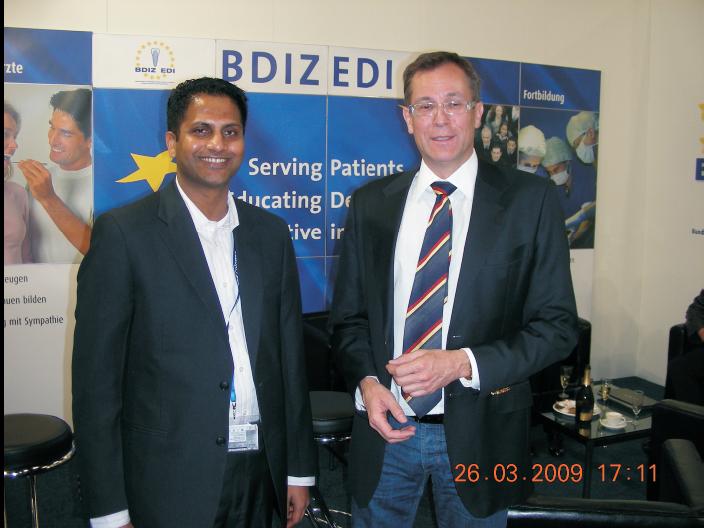
DR. VIKAS GOWD WITH
DR CHRISTIAN BERGER AT THE BDZI EDI
After becoming a member of BDZI_EDI (European society of implant dentistry)
|





